
I have been sick over the past two weeks. Those random Tarot card readings on IG say it’s because my “system” is purging, setting my universe back in order for what is to come. I am a Taurus, so there seems to be some rather profound stuff happening in my world, seen or unseen, and well, my body just got a massive housecleaning.
Head cold → sinus infection → bronchitis
I can’t lay down because the lung butter won’t let me breathe. I can’t sleep because the coughing keeps me awake at night. And I can’t think clearly because, well, I couldn’t see the little 10ml marker on the cough syrup bottle and might have taken too much.
So I spent my nights watching movies.
I was watching a film at 2:30 in the morning recently when a burst of dialogue quite literally made me sit up and rewind the scene. It was the 2018 HBO adaptation of Fahrenheit 451. Beatty, the fire captain, the book burner, the man who destroys knowledge for a living while quoting literature from memory, delivers a line borrowed from Proust. Not paraphrased. Lifted. Placed inside the mouth of the villain, which tells you how sharply the adaptation understood Bradbury’s stakes. Beatty is pure Bradbury: the man destroying literature is also the man who remembers what it contains.
The line was something like this:
So long as you distract your mind from its dreams, it will not know them for what they are. If a little dreaming is dangerous, the cure for it is not to dream less but to dream more, to dream all the time.
I sat with it for a while. I captured a few voice notes into Claude. The film is still on pause. Then I guess I fell asleep. When I woke up, I read my notes, which ended with:
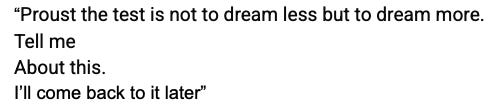
This is me coming back to it.
My Substack - Some Assembly Required - has always been where I work things out in public. It’s where the ideas are longest, sharpest, and least edited for palatability.
We have confused volume for vitality.
The machine produces. We measure. Output is up. Speed is up. The gap between brief and execution has narrowed to something approaching zero. In some agencies, in some studios, in some marketing departments, a brief that once took three weeks now takes three hours. This is genuinely useful. I am not going to pretend otherwise, and I am not going to perform nostalgia for the inefficiencies of the pre-AI workflow. I lived inside those inefficiencies for thirty years. Some of them were romantic. Most of them were just slow.
But here is what we have not yet properly reckoned with.
The friction was not only the obstacle. The friction was also the mechanism.
There are two kinds of friction and they are not the same thing. Production friction — the unnecessary difficulty of making the thing — is worth removing. AI removes it. Good. The kind of friction worth protecting is imaginative resistance: the difficulty of discovering what the thing should be. That is not inefficiency. That is the work.
The gap between what you dreamed and what you could make, that distance, that resistance, that productive difficulty, is where a great deal of the actual thinking happened. It is where you found out whether the idea was real or just attractive. It is where the brief got interrogated instead of merely answered. It is where you discovered, sometimes at significant personal cost, that the thing you thought you wanted to say was not actually the thing you needed to say.
Remove the friction and you get answers faster. You also get answers before you have properly finished forming the question.
Proust understood this more precisely than almost anyone. The full passage, from Within a Budding Grove, is worth the full read:
When the mind has a tendency to dream, it is a mistake to keep dreams away from it, to ration its dreams. So long as you distract your mind from its dreams, it will not know them for what they are; you will always be taken in by the appearance of things, because you will not have grasped their true nature. If a little dreaming is dangerous, the cure for it is not to dream less but to dream more, to dream all the time.
The argument is philosophical, not sentimental. Proust is not telling you to be a dreamer in the inspirational-poster sense. He is making a claim about perception. If you keep your mind distracted, busy, stimulated, moving fast, producing, you will mistake the surface of things for their nature. You will keep being fooled. You will make things that look right but aren’t.
You will answer the question on the brief without ever reaching the question underneath the brief.
The dreaming mind is not the unproductive mind. It is the mind that reaches past the immediate, past the obvious, past the thing that the algorithm can already generate. It is the mind doing the work the machine can assist but cannot complete on your behalf. Not merely the execution, but the search.
Bradbury put it differently, because Bradbury always puts things differently. I read a lot of him in high school, not because I had to, but because my parents asked me not to.
Stuff your eyes with wonder. Live as if you’d drop dead in ten seconds. See the world. It’s more fantastic than any dream made or paid for in factories.
That last phrase is doing a lot of work. Made or paid for in factories.
In 1953, Bradbury was talking about television. The four-wall parlour. The speed culture. The digest-of-the-digest. The politics reduced to a headline, the idea reduced to a slogan, the attention span trained down to the duration of a commercial break. He was diagnosing a society that had traded the difficulty of experience for the comfort of simulation.
The world Bradbury imagined, where the real is crowded out by the frictionless, the fabricated, the fast, is not a dystopia we avoided. It is a description of the content economy we built, and are now accelerating with considerable enthusiasm and venture capital.
More fantastic than any dream made or paid for in factories.
The real world. The physical world. The world of actual encounter, actual friction, actual surprise, the world where 1+1 occasionally equals purple, and you cannot predict it in advance.
A model may generate the image. It cannot have gone somewhere, seen something, and returned carrying the consequence.
I have been writing about the Presence Economy for a while now, from a different angle.
The argument there is about live experience, concerts, dinners, conversations, travel, the things that cannot be streamed or reproduced or served as a notification. To me, the growth of live experiences is a pendulum swing against generated content. It is where authenticity will be validated by being there IRL. I have been watching the premium on those experiences rise in direct proportion to the volume of synthetic content surrounding them.
What I did not fully see, until Proust said it to me at 2:30 in the morning through the mouth of a fictional book-burner, is that the Presence Economy and the creativity argument are the same argument.
The scarcest thing in a world of infinite generated content is not better content. It is the evidence of a mind that actually went somewhere, saw or felt something, and came back changed.
This is what the great photographers understood. You do not take a photograph by standing in front of a subject and pressing a button. You take a photograph by having lived a life that taught you which moment to press the button. The image is the residue of the seeing. The seeing is the residue of the dreaming. And the dreaming — Proust is insistent on this — cannot be rationed, cannot be managed, cannot be optimized without being destroyed.
None of this means the tools are the enemy.
I use them every day. I think in them, structure with them, test arguments against them, produce with them. The tool does not dream. You do. Or you don’t.
The distinction is this: Are you bringing a dream the machine cannot yet follow, and using it to help you build toward that dream? Or are you arriving at the machine without a dream, and accepting whatever it generates as the dream?
The first is a creative practice. The second is outsourcing your imagination to a system trained on what previous imaginations have left behind.
The cure, Proust tells us, is not to generate less. It is to dream more. Not to outrun the machine — but to stop allowing the machine’s capabilities to define the edge of what you are trying to imagine. To keep the reaching alive. To refuse the prompt that satisfies too quickly. To treat the gap between what you dreamed and what the machine produced not as a problem to be closed but as the signal that you are still doing the work that matters.
Become the Book
Montag’s rebellion in Fahrenheit 451 is not that he reads more. It is that he becomes the book. He commits the text to memory, carries it inside him, keeps it alive in a world designed to make living difficult.
That is the creative posture for this moment. Not resistance to the tools. Not nostalgia for the pre-AI workflow. Not the performance of human authenticity as a brand strategy.
Just this: dream all the time. See the world. Keep reaching past the edge of what the machine already knows how to give you.
The real is more fantastic than anything made or paid for in factories.
Go find out what that means. And while you do that, the cough syrup is calling my name.
