
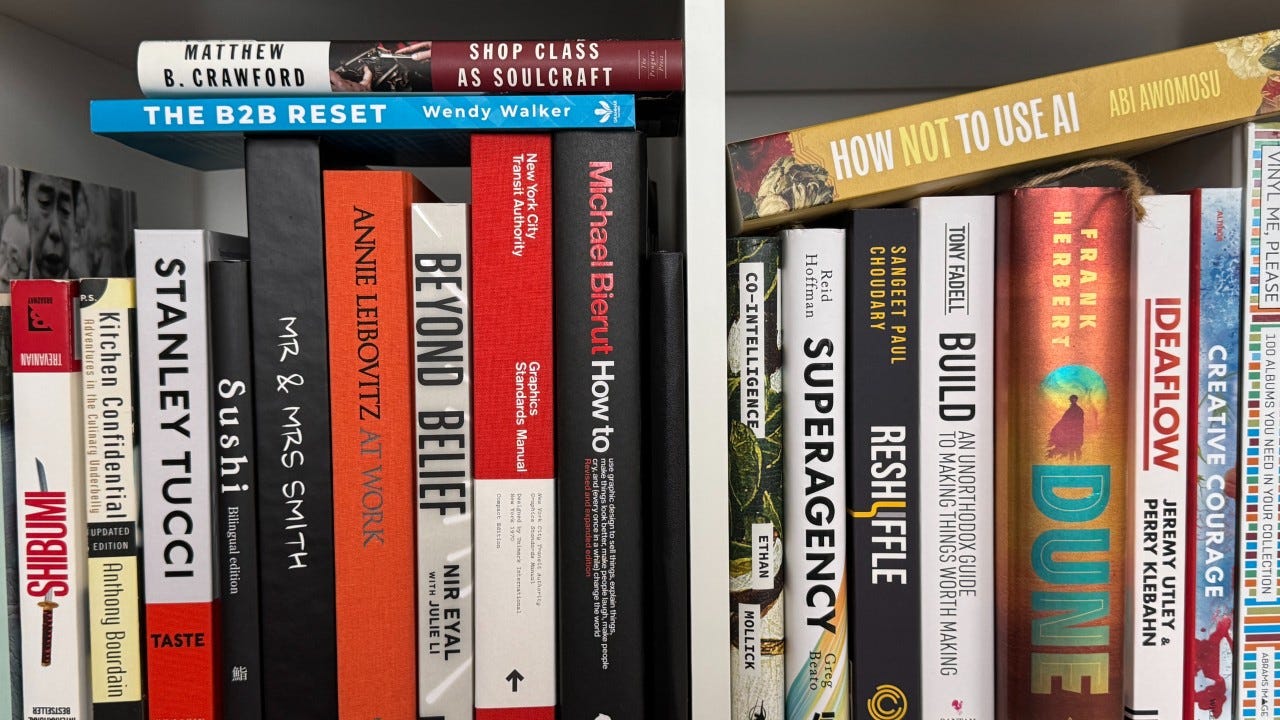
I bought a book last week. Shop Class as Soulcraft, Matthew Crawford’s inquiry into the value of work—hand to tool to material, the kind of competence you can’t fake because the motorcycle either starts or it doesn’t. I hadn’t gone looking for it. I went to the bookstore looking for a different book.
They didn’t have it.
There was the short, familiar disappointment, followed by the obvious next move: go home, find the book I wanted online, click, wait. But I was already in the store, and what I wanted wasn’t only that particular title. I wanted to leave with a book. A new piece of reading. A new way of thinking. Some small insight I hadn’t arrived with.
So I looked at the endcaps. I looked at the bookstore’s recommendations. I let my eyes move across shelves I hadn’t planned to visit.
Shop Class as Soulcraft was there.
My Substack - Some Assembly Required - has always been where I work things out in public. It’s where the ideas are longest, sharpest, and least edited for palatability. If you want to stay connected to where the thinking is going, not just the occasional post that survives the algorithm, please subscribe.
Maybe a bookseller had put it there. Maybe the shop’s merchandising system had. Maybe an algorithm somewhere upstream had helped decide what appeared on that endcap and what sat beside it. Who knows?
When I walked home, I put it on top of the pile of books still waiting to be read. The pile is starting to look like Manhattan’s skyline. And I stood there for a second looking at the shelves underneath it. That’s when I actually counted things.
A bookcase that’s stopped pretending it has room for anything else. About five hundred records. Ten photographs on the walls—mine, shot, printed, framed. A guitar that came out of a case a few months ago when we moved into the new apartment and has been leaning in the corner ever since, freshly tuned up but still waiting for me to remember I used to be good at it.
Look around the office and the apartment, and I see stuff that doesn’t update itself.
I’ve spent six years building my living inside AI. Strategy, workflows, the actual machinery of how creative work gets made now. And somewhere in those six years, I started reading more, listening more, and buying more things that have no API, beacon, or cookie.
That’s not a contradiction. It isn’t a protest against the age of AI, or against the industries that pay my bills—marketing, advertising, and creative work.
The absence of the book I wanted had created a gap. Online, that gap would have been closed almost instantly. In the shop, I had to decide what the visit was for. Was I there to acquire the title I had named, or to come into contact with something worth reading?
The first option had failed. The second remained available.
That gap is where the magic happens.
You go into a record shop looking for one artist or band and come out with something you’d never have typed into a search box, because you don’t know what you don’t know until it’s in your hands. You go to a restaurant you already know because you want to see what’s changed. Or you walk past a shop door you’ve never opened, and open it.
None of these experiences are unmediated. Someone chose which records to stock. Someone designed the menu. Someone decided which books belonged on that endcap.
Maybe recommendation isn’t the right dividing line. Maybe the difference is between being predicted and being encountered.
A bookstore shelf is a recommendation system. It has inputs, judgments, commercial pressures and, increasingly, perhaps algorithms behind it. The question isn’t whether the recommendation exists. The question is what kind of recommendation it is.
A personalized system begins with a model of me. It knows what I’ve clicked, bought, paused over, searched for, and perhaps abandoned. It looks at that trail and has a go at guessing what I’ll want next. Sometimes it gets it right. If I already know the title, I’m perfectly happy to type it into a search box and get on with my day. Sometimes that is exactly what I want. If I know the book I want, I’m grateful for a search box that finds it. If I need a replacement stylus for a record player, I don’t necessarily want a pilgrimage. Convenience is not the enemy.
But the recommendation on the shelf gave me a possibility without giving me a conclusion. It didn’t know whether Crawford would suit me. It didn’t know what I had read last week or what I was in the mood to become. It simply made the book available to my attention and left some work to me.
An algorithm can absolutely show me something I didn’t know I wanted. The harder thing is showing me something that changes what I think I want before the system has worked out that I’m likely to want it.
That’s the value of the shelf. Not that it is free from selection. Not that it is pure, analog or somehow outside the market. It is that the selection is imperfect, contingent and incomplete. It gives me a context but not an answer.
Discovery is not the absence of mediation. It is what happens when the mediation leaves some of the decision unfinished.
Digging for vinyl, buying books, eating at a place with no delivery—none of that is outside the market. It is the market. A well-marketed one, at that. “The analog revival” has its own aesthetic now, its own Instagram accounts, its own tote bags.
The bookstore may have used sales data to decide what went on the endcap. The shop’s recommendation shelf may have been influenced by an algorithm. The fact that I experienced the discovery as mine doesn’t prove that the discovery was untouched by systems.
I’m not claiming immunity from being sold to.
What I’m claiming is narrower: the process of finding the thing was still mine, even when the appetite for wanting to find it wasn’t entirely mine. I had to be there. I had to notice. I had to decide that failing to find the book I went in for didn’t mean the trip had failed. I had to take the small risk of buying a book without much evidence that it was a book that I didn’t know I needed to read.
The system may have helped put the book in front of me. It didn’t finish the experience.
There’s a version of me—professionally, the version that gets paid—who spends his working hours making machines better at anticipating what people want before they’ve asked. I’m not passive in that work. I’m choosing constantly: what matters, what to pursue, what to ignore, what to build. But those choices usually have a job to do. They’re pointed towards an outcome.
I’ve started to notice the specific tiredness that comes from a day spent inside systems that finish your sentences, followed by a much different feeling during an evening spent standing in a bookshop, deliberately not knowing what’s on the next shelf.
One is choice with a brief. The other is choice without one. I think I need both.
Some Things Need Trying On
I rarely buy clothes online. When I do, it’s usually some novelty T-shirt with a logo of a company that is no longer around, which signals how cool I am. I could easily buy a new pair of jeans online; I have worn the same size for years now. But I prefer to walk to the shops; maybe they have my size in stock, maybe they don’t. Maybe I’ll choose a different cut, try it on, and realize, for the 30th time, that I no longer look good in skinny black jeans.
Maybe that is the thing I am enjoying about analog experiences. The Maybe.
We work on machines built to know us. We look down more than we look up. We move our thumbs considerably more than we move our feet. None of that makes the machines wrong. It just means the thumb and the feet are doing two different jobs, and only one of them is optimized for arriving.
The other one is still useful for wandering.
I don’t know yet whether this is a return to something or the start of something new—Crawford would probably say those are the same question, badly asked.
I do know that a life built entirely around better prediction of the person I have already become would be a strangely narrow life. There should still be places where I am not fully understood. Places where I can encounter something before I know what it says about me.
The guitar is still in the corner. I haven’t finished the book. The shelf is full of things chosen by someone, somewhere. Some arrived through recommendation. Some through accident. Some through years of wanting. Together, they are a record of decisions, detours, failed searches and changed minds.
Or maybe they arrived in my apartment because on that particular day, I had just gotten paid for a project, and I had money burning a hole in my pocket.
Maybe that is the thing I’m enjoying about analog experiences. The Maybe. Not the certainty that I’ll find what I want, or even that I’ll make the right choice. Just the possibility that I might encounter something I hadn’t come looking for and decide it belongs with me.
