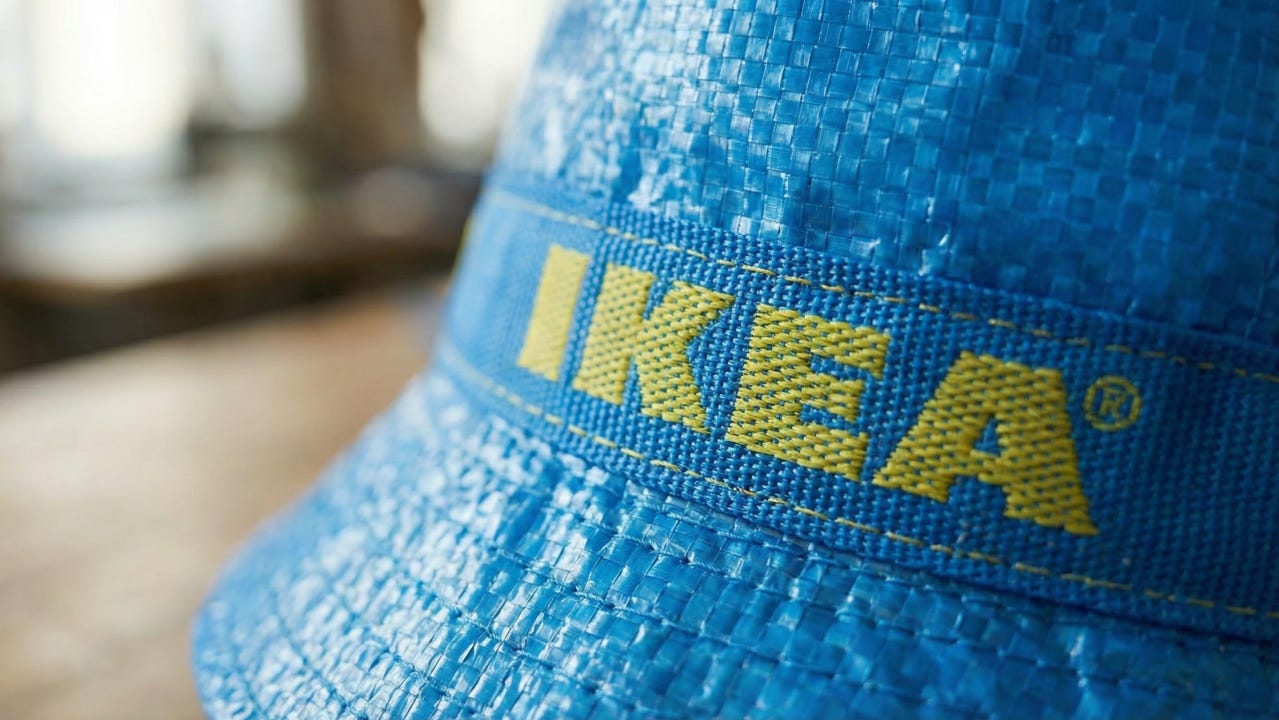
The Bucket Hat Experiment
Most brand storytelling still works the same way it did twenty years ago. Big ideas. Big budgets. Long production cycles. But generative tools are quietly changing something more fundamental than production speed.
They are changing the role of experimentation in storytelling.
Instead of asking whether an idea is worth producing, we can now explore ideas quickly — visually, cinematically, and iteratively. Sometimes those experiments begin with something very small.
In this case, it began with a pile of IKEA bags falling out of a storage closet.
When “The Bag” Stops Being a Bag
Last Friday night, I opened a storage closet in our apartment, and a small avalanche of blue IKEA bags tumbled onto the floor.
You know the ones. Durable, oversized, almost indestructible. The bags everyone seems to accumulate over time.
Standing there looking at the pile, I started thinking less about what they carried and more about what they were made of. The material is an interesting contradiction — waterproof and tough, yet flexible enough to collapse flat. And that’s when the thought appeared.
This would make a great hat.
A bucket hat, specifically. Crown, band, downward brim. A simple structure that could easily be cut and stitched from the bags themselves. But as often happens when I start thinking about objects, the idea didn’t stop at the object.
Could I turn the process of making that hat into a short film?
Not a product demonstration. Not a tutorial. A small cinematic piece showing a familiar everyday object transforming into something entirely different.
Why Brands Should Pay Attention to Experiments Like This
At first glance, a film about turning an IKEA bag into a bucket hat might feel like a small curiosity. A creative exercise. A weekend experiment.
But projects like this are quietly becoming an important part of how brand storytelling is evolving.
For decades, brand films were expensive to produce and slow to iterate. You wrote a script, assembled a production team, rented equipment, booked locations, and shot everything within a tightly scheduled window. The cost structure meant that most ideas were explored only once — and often only partially.
What generative tools are beginning to change is not just the speed of production. They are changing the relationship between experimentation and storytelling.
You can now test ideas the way designers prototype objects. Instead of asking “Is this idea worth producing?” you can ask “What happens if we explore this idea?”
The bucket hat film sits exactly in that space.
It begins with a familiar object that already lives inside millions of homes. The IKEA bag is not just a bag — it’s a cultural artifact. Instantly recognizable. Universally understood. A piece of design that has quietly embedded itself into everyday life.
By transforming that object into something else — a hat — the film taps into a different kind of storytelling. Not advertising in the traditional sense, but reinterpretation.
A reminder that the most powerful brand stories often begin with the objects people already know.
The Film as an Experiment.
Over the past year, my work at RockPaperScissors has increasingly involved generative tools — not just for imagery but for motion, scene construction, and story development. These tools are incredibly powerful, but they also come with a strange side effect: people tend to use them to produce finished things before they understand how those things are built.
With generative tools, the process becomes even more modular. Instead of filming everything in sequence, you build scenes piece by piece, often in a non-linear way. A first frame. A motion instruction. A constraint that prevents the camera from drifting or reshaping objects unexpectedly.
Sometimes the work feels less like filmmaking and more like constructing a mechanical system. Which is why I often describe what I do as scene mechanics.
The bucket hat film was built exactly this way: a series of small controlled experiments designed to produce reliable motion and visual continuity.
For this experiment, I only wrote about 25% of the image or motion prompts. Instead, I wrote system prompts that analysed the creative brief, my “director’s vision” notes, and key frame image references.
I use Figma Weave as my go-to production environment, so I was able to create a workflow that included prompt interpretation, scene planning, motion design, and shot construction.
In effect, the system was doing something very similar to what happens on a film set. Instead of writing every prompt manually, I was establishing the creative constraints, the visual language, and the intent of the scenes—and instructing the system to generate the detailed prompts required to build them. All in one environment. Every step part of a connected workflow.
In other words, I wasn’t prompting images. I was orchestrating a system.
Why Simple Ideas Are the Best Experiments
There’s another reason I chose such a small concept. When people experiment with AI filmmaking, they often start with ideas that are far too large — epic landscapes, complex action sequences, cinematic spectacle.
Those ideas quickly collapse under the weight of technical limitations.
A single room. A table. A bag. A tailor.
This kind of constrained environment is much easier to control. It allows you to focus on craft: lighting, motion, object interaction, continuity. And because the concept is simple, the viewer’s attention naturally shifts to the transformation itself.
The bag becomes fabric. The fabric becomes form. The form becomes a hat. A familiar object quietly turning into something new.
From Experiment to Film
Eventually, the pieces began to assemble into something coherent. A short film about craft. About transformation. About seeing potential in everyday materials. But it was also something else - a demonstration of how generative tools can be used not merely to produce content, but to explore ideas, test visual sequences, and prototype stories quickly.
The bucket hat itself almost becomes secondary. What matters is the process.
The curiosity that begins with an ordinary object on my apartment floor and gradually evolves into a small cinematic world.
Experimentation Is Becoming a Strategic Capability
For brands, this shift matters more than it might initially appear.
The companies that will win in the next era of storytelling are not simply the ones that produce the biggest campaigns. They are the ones who experiment more frequently.
Small films. Unexpected ideas. Visual prototypes. The storytelling landscape itself is evolving quickly. New formats are emerging almost faster than agencies and brand teams can keep up.
Vertical micro-dramas designed for phones. Short scripted stories where brands are integrated naturally into the narrative rather than appearing as obvious placements. Narrative experiments that explore objects, materials, and rituals around a brand.
These aren’t traditional campaigns. They’re story experiments — small narrative explorations that test tone, symbolism, craft, and format. Some of these experiments will go nowhere. A few will reveal something interesting. And occasionally, one will unlock an entirely new creative direction.
This is exactly how innovation tends to happen in every other field — from product design to software development. Iteration leads to discovery.
Storytelling is beginning to work the same way.
Craft Still Matters
There is one important caveat. The rise of generative tools does not eliminate craft. If anything, it makes craft more important. Because when anyone can generate images instantly, the difference between mediocre work and meaningful work becomes the intentional construction of scenes. How motion unfolds. How objects interact. How the camera behaves. These are the mechanics that give a film its credibility.
The bucket hat experiment may look simple on the surface, but every scene is carefully constructed. The cutting of the bag. The motion of the tailor’s hands. The rhythm of the sewing machine. The transformation of material into form.
In other words, the same fundamentals that have always defined filmmaking still apply. Generative tools simply give us a new way to explore them.
The Real Opportunity for Brands
The most interesting part of this moment is not that AI can produce images or videos. It allows brand storytellers to think with motion. To prototype ideas visually. To test narrative structures quickly. To explore metaphors that would previously have been too expensive or impractical to produce.
For brands, this opens an entirely new creative territory. Not just campaigns. Not just commercials. But a continuous stream of story experiments that deepen people’s experience of the brand.
Sometimes those experiments might start with something as simple as a bag falling out of a closet.
And occasionally, if you follow the idea far enough, you end up with a bucket hat.
If You’re Curious About What’s Possible
If you happen to know someone at IKEA, I’d love an introduction. After spending the day turning their bags into hats, it feels only fair that they get to see the film.
But more broadly, experiments like this are exactly how I explore what generative storytelling can do for brands.
If you’re a brand looking for ways to step into the world of AI-supported storytelling — or an agency working with a client that has great stories to tell, big or small — I’d be happy to talk with you.
Sometimes the most interesting brand stories don’t begin with a campaign brief. Sometimes they begin with something much simpler.
A message.
Before Anyone Asks
IKEA is not a client of RockPaperScissors. This was a speculative experiment built purely out of curiosity and a pile of blue bags in a storage closet.
Also, no IKEA bags were harmed in the making of this film. One simply found a new career as a bucket hat.


