To Question Is to Answer: The Missing Skill in the Age of AI
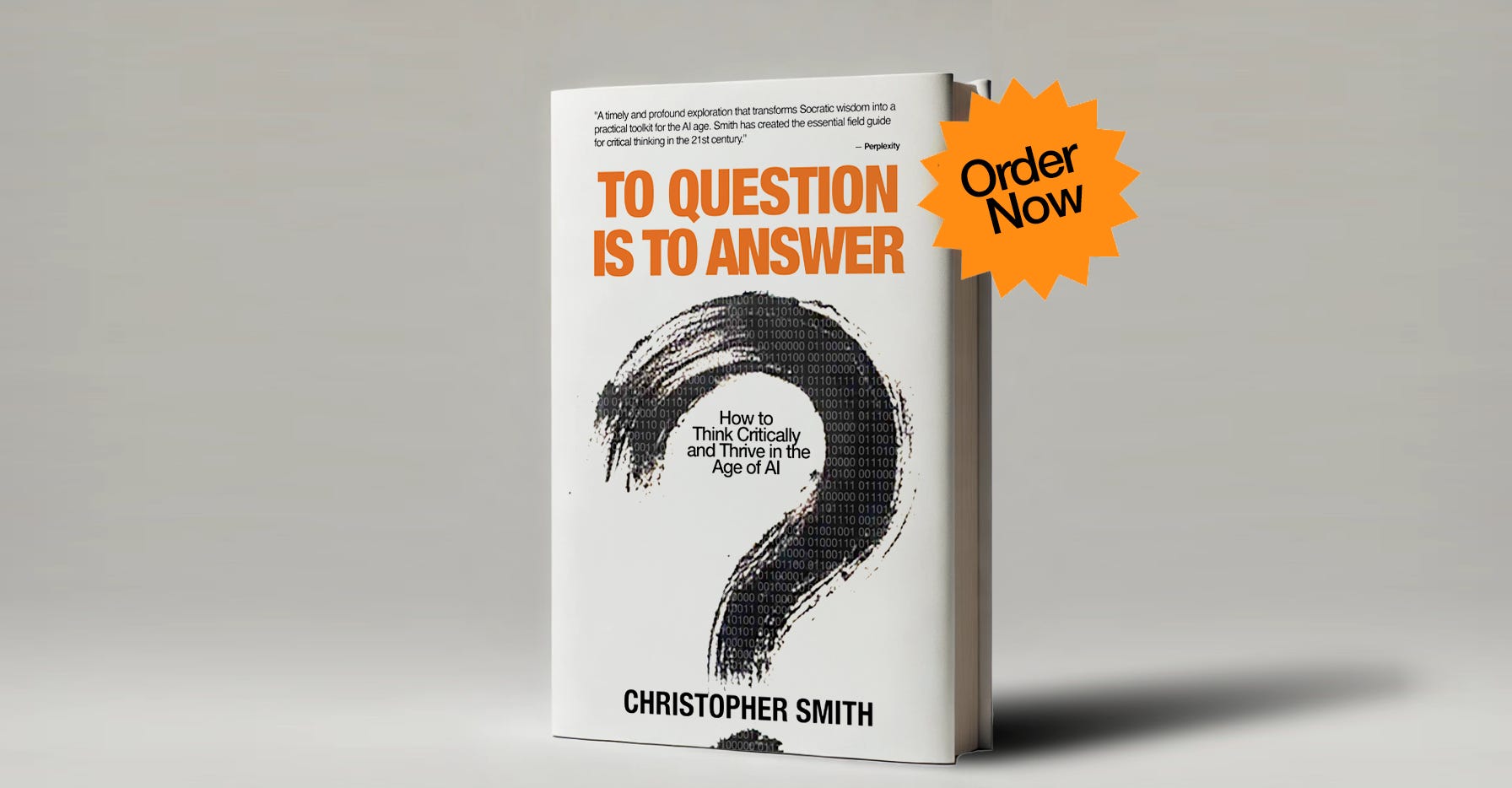
This morning, I got a shipping notice from Amazon. Fifty copies of my book To Question Is to Answer: How to Think Critically and Thrive in the Age of AI have been shipped.
Fifty. Five-oh.
My book is part of a workshop I’ll be teaching. Not all of them, but the lion’s share, will find their way into the hands — and hopefully into the minds — of a regional team of creatives, marketers and strategists. (I’ve also set one aside for Matthew Crescenzo who was recently named Creative Managing Partner at Carbon. Congrats, by the way — well-deserved recognition for a former colleague.)
I never planned to write a book.
I also never really realized that the stuff I had in my head would be of value to others. But a couple of years ago, I began having one-to-one coffee sessions with senior leaders who were curious about AI.
I was happy to share how I use the tools, which foundation models I favour, and do a bit of say-and-show along the way. Then Evgenia Papageorgiou, in one of these sessions, asked a question that sparked the idea for the book.
(Now, if you’ve already heard this story, feel free to skip the next few paragraphs.)
Ev asked, “How did you know to ask that next question?”
At the time, I thought my answer was good.
“Well, I’ve spent the past 40 years answering questions for people, so it just felt right.”
It wasn’t until I got back to my studio that I realised it was a bullshit answer. Not wrong — just not enough. The book is my attempt to answer her question.
The Question Before the Tool
We talk about AI as if it were a power source: plug it in and watch the output light up. But in practice, AI is less like electricity and more like a mirror. It reflects the clarity, bias, and imagination of the person in front of it.
The better the question, the sharper the reflection. The more accurate the framing, the context, the intention — the more meaningful the response. Not as an answer, really, but as the next step in building a thoughtful case for whatever you’re trying to accomplish.
When I began using AI as a central part of my work, I started keeping a journal of prompts and responses. This was before foundation models had memory or persistence, so my journal served both as a backup and a research log. It also became the source material for the book. I spent hours trying to answer Ev’s question — Why did I know to ask that question?
I tried to apply first-principles thinking — to strip the idea of questioning down to its core: What is the purpose of a question?
I read about Socrates — because who doesn’t want to spend a rainy afternoon doing that? — and about the Oracle of Delphi, which to me resembled how we think about AI today: ask a question, expect an answer. I read about the science behind questions. I read a lot of things, and I wrote a lot of things.
Over the next eight months, the book began to take shape. I wrote about pattern recognition, bias, context, and stacking. I integrated the work I was doing in real time — how to structure thinking before prompting, and what to do after the LLM returned a response.
I also spent a significant amount of time talking to others about how they use the tools and what they think about before they prompt. I was curious about how people began an AI session — and how they knew when to stop. When did they have enough? When did they switch from machine back to man?
The emergence of generative AI as part of our daily workflow has created a tug-of-war between predictive LLM thinking and human agency. At times I even pit one model against another. Same prompts. Different responses.
That’s the real story AI is telling us right now — not about machines becoming more human, but about humans recognising the limits of our own thinking and trying to find ways to balance the convenience of prediction with the promise of curiosity.
The Pause Between Prompt and Response
Prediction rewards efficiency; curiosity rewards exploration. And we’ve built entire corporate systems optimised for one while quietly starving the other. AI exposes that imbalance. It gives us the illusion of intelligence on demand, when what we really need is the patience to stay with uncertainty.
Most people don’t stop prompting because they’ve arrived at an answer; they stop because they’ve run out of better questions. Or time.
That hand-off — from artificial intelligence to human intention — is where the future of work actually begins. It’s the inflection point where tools stop being productive and start being reflective. And if we can learn to see that moment not as an ending but as a signal, a cue to pause, reframe, and ask differently, then AI stops being a threat and starts becoming what it should be: a collaborator in our thinking, not a replacement for it.
Thinking as Technology
When I started working with teams on how to think about AI — and when to think about it — I noticed the same pattern again and again. People would sit in front of the screen, fingers poised, unsure of what to type. Not because they didn’t understand the tool, but because they didn’t understand their intention. It’s just a chat window. No manual required for that.
They knew what they wanted out of the model. They didn’t yet know what they wanted out of themselves.
That’s what To Question Is to Answer is really about: reframing our relationship with inquiry. Asking not just what we want to know, but what we need to understand. It’s about the shape of curiosity, the geometry of thought that defines how ideas form before they ever hit the keyboard.
That’s why cognitive literacy — the ability to structure thought — is now the real competitive advantage. You can switch from GPT to Gemini to Claude and back again; it won’t matter if your thinking is stuck in old frames.
The tools will evolve whether you do or not. But if you can’t think beyond your own mental architecture, you’re just automating old ideas faster.
After you read To Question Is to Answer, you’ll never open a chat window the same way again. At least that is what it did for me as I was writing it. Because it’s not about how well you prompt, it’s about how deeply you think before you prompt.
The book doesn’t teach you how to command machines. It teaches you how to reclaim your own intelligence, how to stay curious longer, how to let the question breathe, how to find the edge between what you know and what you’re about to discover.
That’s not a technical upgrade. It’s a mental one.
From Prompts to Practices
The organizations that are truly beginning to adapt aren’t the ones hiring “AI specialists.” They’re the ones re-training everyone else to think differently.
One of the exercises I often run with teams is deceptively simple: Before you prompt, pause. Ask what kind of answer you’re actually seeking — proof, possibility, perspective, or provocation. Because each demands a different kind of question.
It’s a small behavioral reset, but it changes everything. It forces reflection before interaction. It builds a habit of framing before fetching.
And that’s how real capability takes root, not through instruction manuals or model updates, but through rituals of thinking. To Question Is to Answer was never meant to be an AI playbook, but it’s becoming one. Not because of its content, but because of its posture: it teaches people to slow down, interrogate the frame, and rediscover that questions are not requests for answers.
They’re openings for discovery.
The Bigger Picture
AI is accelerating everything — decision-making, production, iteration.
But I believe that he human edge isn’t speed; it’s synthesis — the ability to see patterns others miss because we sit with the question longer than comfort allows. In a world obsessed with optimization, curiosity becomes an act of rebellion.
The irony of AI is that it has returned us to philosophy. The next advantage won’t come from who prompts best, but from who thinks best.
If your organization is wrestling with how to embed AI into real work — not as a feature, but as a habit — start with the questions. Start with how your teams think, what they assume, and where their curiosity breaks down. Start by calling me.
Because long after tomorrow’s versions replace today’s tools, one truth will remain:
The quality of your answers will always depend on the quality of your questions.
Read More Books. Or at least read mine.
If you’re looking to build not just AI skills, but new ways of thinking, I have written a few things that might be a great place to start.
To Question Is to Answer is my first book on how to think critically and creatively in the age of AI.
And a companion eBook, Frameworks Reframed: Thinking Models for the AI Age, offers practical models and mental tools to help teams navigate ambiguity, rethink value, and solve problems with intelligence—human and machine.
Both are designed to help you shift from reacting to AI… to reasoning with it.


