

For most of my working life, the deliverable decided where the work began.
If the client needed a presentation, I opened PowerPoint. If I was writing an article, I opened Word. If somebody wanted a film treatment, a strategy document or a point of view, I opened whichever application seemed most likely to produce the correct-looking object at the end.
I thought I was choosing a tool. I was actually choosing the shape of the thinking before I had done any of it.
The moment you open PowerPoint, you begin thinking in slides. How many will there be? What’s the headline? Can this argument fit above the fold? Where does the chart go? Which piece of evidence deserves a full page? How much text can survive before someone says it isn’t visual enough?
None of those are ridiculous questions. Eventually, they matter. But they arrive far too early.
Before the argument is ready, it is already being compressed. Before the evidence has been properly interrogated, it is being arranged. Before you know what you think, you are deciding what it should look like.
The presentation has begun presenting before the thinking has finished thinking.
My Substack - Some Assembly Required - has always been where I work things out in public. It’s where the ideas are longest, sharpest, and least edited for palatability.
The file before the thought
This isn’t only a PowerPoint problem.
Word encourages document-shaped thinking. The blank page quietly assumes there will be a beginning, a middle and an end. Excel invites the world to become rows, columns and formulas. Creative software encourages us to start making the thing before we’ve understood what the thing is for.
A film director would never claim the trailer contains everything worth knowing about the film. A creative team knows the final campaign isn’t the same thing as the observations, arguments, rejected routes, cultural tensions and choices that produced it.
And yet in strategy and knowledge work, we routinely treat the finished deck as both the source and the final expression of the thinking.
Then, six months later, somebody wants to update it. The original team is gone. The source links are buried in someone’s inbox. Nobody remembers why one argument survived and another disappeared. A chart has been copied so many times that its origin is now “the previous deck.”
The organization still has the presentation. It has lost most of the intelligence that made the presentation possible.
The suspicious little .md file
I arrived at this by way of a file extension I’d barely noticed before.
.mdMarkdown.
I’d seen these files sitting inside AI tools, coding environments and project folders and assumed they belonged to developers — the unglamorous plumbing the rest of us weren’t expected to understand.
Then I opened one.
Markdown is almost comically simple. Plain text with a few lightweight signals describing the structure of what you’re writing. A hash mark identifies a heading. Two hash marks, a section beneath it. A dash makes a list. A pair of asterisks adds emphasis. That’s roughly the level of technical sophistication required.
# The Epilogue Economy

## The Problem

People are living longer, but many of the systems around them
were designed for shorter lives.

### Three consequences

-Longer careers
-Longer consumer lifetimes
-New definitions of retirement

> Longevity isn't simply changing old age.
> It's changing the architecture of adulthood.

**The opportunity:** rethink the second half of life.
There’s virtually nothing proprietary there. You can open it in a text editor and understand it immediately.
But a machine sees considerably more than prose. It sees:
Title → section → subsection → list → quotation → emphasis.
That’s the important distinction. Markdown separates meaning from appearance.
A Markdown heading knows it’s a heading. It doesn’t know whether it will eventually become 32-point Helvetica on a black slide, a section in a report, a webpage title or a line inside an email briefing. It knows what the information is without deciding how the information must look.
The absence of presentation is the feature.
The source and the rendering
This led me to a distinction that feels obvious in software and strangely unfamiliar in most executive work: the source and the rendering do not have to be the same object.
A webpage is not its source code. A finished film is not its footage, script, production notes, and edit timeline. A television commercial is not the strategic and creative history that produced those thirty seconds.
But we often behave as though a strategy deck is the strategy.
What if the deck were simply one rendering of a deeper, more complete source?
That source might hold the original question, the research and its links, what we observed, what we inferred, the assumptions we made, the tensions we haven’t resolved, the options we rejected, the decisions and their rationale, the current argument, what’s changed since the last version, and what we still don’t know.
Not all of that belongs in the presentation. It may belong in the strategy.
Once that source exists, the Board deck becomes one possible rendering of it. So does the creative brief. So does the two-page executive summary, the internal FAQ, the keynote speech, the client workshop, the campaign narrative, or the background document handed to a new team six months later.
The source is durable. The renderings are situational. Think of Markdown as a source format rather than a destination format.
You might begin with:
Research → thinking → argument → source
Then render that source as:
a Word document
a website
a presentation
a PDF
a newsletter
an article
AI context
database or CMS content
That’s a very different philosophy from starting in PowerPoint. If you start in PowerPoint, you’ve already made dozens of decisions about the eventual container. If you start upstream, you’re essentially saying: Let’s establish the canonical version of the thinking first. Then decide how it should manifest.
Markdown happens to be an extraordinarily simple way of doing that.
The deck is a compression artifact
This distinction mattered before AI. It matters far more now.
The most obvious use of AI in knowledge work is to put a copilot inside the applications people already use. Help them make the deck faster. Summarise the Word document. Suggest a formula. Rewrite the email.
Useful, certainly.
It also leaves the existing architecture of knowledge work almost completely untouched. We still begin inside the intended output. We still trap thinking inside finished documents. We just produce those documents faster.
The larger opportunity sits upstream. A strategy deck may represent the final compression of hundreds of pages of research, interviews, competing hypotheses, cultural observations, rejected arguments, conversations, and judgment. Most of that material is deliberately removed before the deck reaches the boardroom.
That’s not a flaw in PowerPoint. That’s what a presentation is supposed to do. A good deck is selective. It compresses. It edits. It removes complexity in service of a particular audience and a particular decision.
Which means the deck is already a compression artifact.
AI can read a PowerPoint file. That was never the problem. The problem is that AI cannot reliably recover the thinking that was removed to make the PowerPoint concise. It can infer what might once have been there. It cannot recover what no longer exists. So when we ask AI to work from the final deck, we’re asking it to work from whatever survived the compression.
Give it the source instead — the evidence, argument, assumptions, decisions and unresolved questions — and something different becomes possible.
The CMO can get the commercial argument. The creative team can get the human tension. The filmmaker can get the emotional world, characters and possibilities. The board can get the decision, risk and consequence.
The source stays consistent. The rendering changes according to who needs it and why.
This isn’t content repurposing. It isn’t turning one article into twelve social posts and calling it a strategy. It’s preserving the intelligence upstream so different outputs can be generated without rebuilding — or quietly distorting — the thinking underneath them.
The organizational attic
Now scale that problem beyond one person and one presentation. Imagine a company that has commissioned hundreds of strategy projects over the past decade. Brand strategies. Customer studies. Innovation programs. Category analyses. Cultural research. Campaign post-mortems. Competitive reviews.
In theory, that company possesses an extraordinary body of institutional intelligence.
In practice, much of it lives in SharePoint folders full of PowerPoints, PDFs, Word documents and spreadsheets. There are final presentations, final-final presentations, presentations copied from presentations, charts whose provenance has disappeared, and decisions whose rationale left the company with the person who made them.
The organization has accumulated knowledge without necessarily building a knowledge system. It has an organizational attic. This was inefficient before AI. It becomes a strategic constraint with AI.
Companies are now spending extraordinary amounts of money trying to make their organizations “AI ready.” Much of the conversation is about models, licenses, copilots, agents, and training.
But an AI system can only reason with the intelligence it can access.
If twenty years of organizational thinking has been repeatedly flattened into presentation artifacts, the problem isn’t simply whether your AI can open PowerPoint. The problem is that much of the connective tissue — why a decision was made, what evidence challenged it, what was rejected, what changed, what remained unresolved — was never preserved in the first place.
AI readiness is therefore partly a knowledge architecture problem. And that raises a much more consequential question than whether your team should start using Markdown:
Where does your organisation’s thinking actually live?
If the answer is PowerPoint, Word, PDFs, email threads and people’s heads, no Copilot licence fixes the underlying problem.
The deck has a half-life. The thinking shouldn’t.
For decades, the deliverable was the asset. The deck, the report, the PDF — that was the culmination of the work. Once it was approved, sent, or presented, the project felt complete.
But a presentation is built for a particular audience, at a particular moment, for a particular decision. That’s precisely why it can be so valuable. And precisely why its value is temporary. Change the audience, the moment or the decision, and the presentation needs to change with it.
The source can be more enduring. It can be challenged against new evidence. Compared against previous thinking. Updated without pretending the past never happened. Recombined with material from another project. Handed to a future AI system as context. Rendered into a format that didn’t exist when the original work was made.
The deck has a half-life. The intelligence that feeds it shouldn’t. The project is no longer fundamentally a deck. It can become a knowledge system.
Markdown is not magic
None of this means every executive should abandon PowerPoint and start writing Markdown files. Nor does putting .md at the end of a filename make the contents intelligent.
A badly structured Markdown file becomes just another stale document. It can lose its sources, duplicate another version, bury assumptions and preserve conclusions long after the circumstances that produced them have changed.
Canonical knowledge needs more than plain text. It needs discipline around provenance, structure, versioning, decisions, connections, ownership and updating — around what’s active and what’s already been superseded. And Markdown isn’t inherently good at sophisticated layouts, art direction, complex diagrams, pixel-perfect presentations, elaborate tables or highly visual storytelling.
But that’s almost the point. Those things belong later in the pipeline.
Markdown is useful at the stage where you’re asking:
What do we know? What do we believe? What’s the argument? What’s the hierarchy? What supports what? What’s missing?
Then you move into design.
Markdown isn’t the solution. It’s a simple doorway into the principle. It makes it easier to see that intellectual work has a source layer and an output layer, and that we’ve spent a very long time building organizational knowledge almost entirely inside the second one.
I wouldn’t argue that Markdown is the best format. I’d make a slightly different claim:
Markdown may be one of the best formats for knowledge to exist in before you decide what that knowledge needs to become.
In an AI-native workflow, that distinction becomes much more important. The valuable asset is increasingly not the PDF, presentation or webpage at the end. It’s the structured, machine-readable body of thinking upstream from all of them.
That’s why “Markdown-first” is potentially much bigger than a writing preference. It’s an architecture for how intellectual work gets created, interrogated, reused, and ultimately published.
I have already changed how I work
I didn’t arrive at this because somebody persuaded me Markdown was superior. I arrived at it because I started working differently.
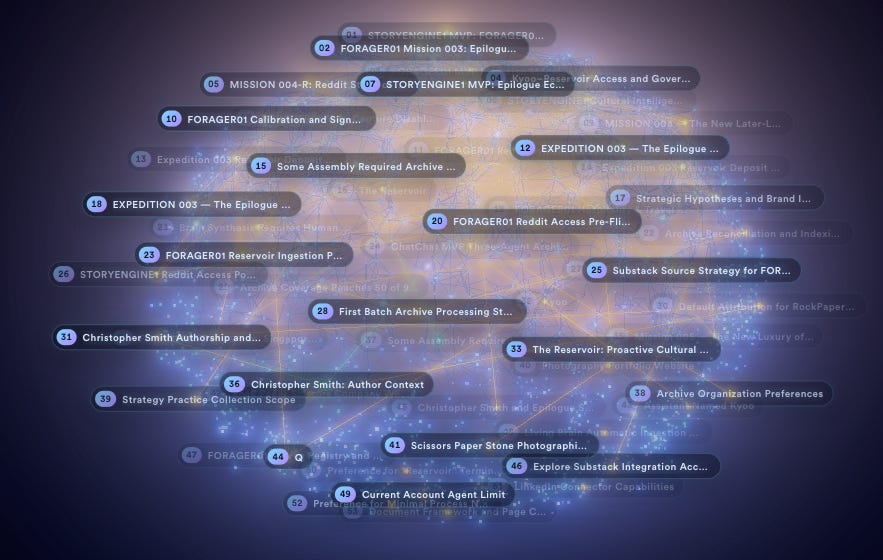
I recently began building what might be called “My Brain.” When Christel Buchanan and her team introduced ChatChat and their “Living Brain” concept, I decided to use this platform to not just archive my years of work, like another file structure, but to build out a canonical record of how I see the world.
Into it went 92 published essays, my book - To Question is To Answer. How to Think Critically and Thrive in the Age of AI, a handful of e-Books I have written, years of strategy thinking, project notes, photography, visual stories, and a considerable number of ideas that had never quite found the right form. Not simply the finished things, either. I included exploratory notes, abandoned directions, film scripts, production notes, systems architectures and master prompt libraries, contradictions and arguments whose edges I was still picking at. I even added an inventory of my vinyl collection via Discogs.
Once the material was brought together, connections began appearing across work that had previously lived in separate folders and formats. An essay about AI shared a concern with a strategy document about later life. A photographic story carried the same tension as a framework about power. Questions about judgment, agency, control, authorship and the institutions we quietly end up running for ourselves kept resurfacing in different clothes.
My Brain does not simply remember what I have written. It remembers the backstory: where an idea began, whether I developed or abandoned it, what it connects to, and where I may have contradicted myself. A contradiction is not automatically an error. It may be evidence that the thinking moved.
And beneath much of it sits the humble .md file, not the intelligence itself, but a simple way of preserving structure without trapping it inside a final format.
This changes how new work starts
A fresh observation no longer lands on an empty page. It arrives inside an accumulated body of thought. I can ask my brain whether I have explored it before, whether it develops an existing argument, whether an apparently new idea is simply familiar language in a better jacket, or whether two things I made years apart have finally found a reason to meet.
It does not decide what I should think next. If anything, its value is that it makes repetition, unfinished arguments and comfortable assumptions harder to hide from. It provides continuity and occasionally some useful resistance.
And because the underlying source, that little .md file, is preserved independently of any final format, the same body of thinking can become an essay, a presentation, a talk, a strategy, a film or something I have not yet imagined.
An article I recently wrote didn’t begin with the thought: I need a Word document. It began with a cultural signal. The signal became a research question. The research became a set of patterns and tensions. One of those tensions became a provocation. The provocation became an editorial structure. Only then did it become an article, and eventually, a Word file.
The Word document was useful. I needed it to edit, read, and move the piece toward publication. But it was a rendering of the thinking. It was not where the thinking lived.
That’s a fairly substantial change in behavior for someone who has spent most of his working life making decks and documents.
I no longer begin by asking what file I need to produce. I ask what source of intelligence I need to build. The file can wait.
A different way to begin
This doesn’t require an enterprise transformation program.
Next time somebody asks for a strategy deck, resist opening PowerPoint for a little while.
Begin somewhere less committed to the final shape. Write down the question. What you believe. What you know. What you’re assuming. What contradicts the convenient answer. What decision the work eventually has to support. What remains unresolved.
Give the thinking a structure before you give it a template.
# Brand Strategy

## The Cultural Shift

## What We Believe

### Evidence

### Implication

## Strategic Opportunity

## Creative Territories
Preserve the sources. Record why choices were made. Let the argument change without spawning eleven files called FINAL_v7_REVISED_USE_THIS_ONE.
Then, when the thinking is strong enough, decide what it needs to become for this audience. Maybe it becomes a deck. Probably it will. But the deck will no longer have to carry the entire intelligence of the work by itself.
Think upstream. Publish downstream.
The .md file isn’t revolutionary. That may be why it’s useful. It’s a small, almost trivial object that exposes a much larger mistake — we’ve confused the format in which knowledge is communicated with the place where knowledge should live.
AI makes that confusion expensive. When any piece of structured thinking can become many different outputs, the strategic question is no longer how quickly you can produce the deliverable. It is whether the intelligence underneath it survives the rendering.
Your deck is not your strategy. It is one expression of it. The strategy needs somewhere else to live. So the next time somebody asks for a presentation, begin with the least impressive file in the room: a blank .md file.
Put the question at the top. Build the argument underneath it. Preserve the evidence, assumptions, tensions and decisions that the final deck will inevitably compress. Build something that can outlive the template.
Start in Markdown.
