Why I’m Taking the Cannes Lions Creative MBA (Even Though I’ve Been Critical of Cannes)
I have never been to Cannes. I have never been part of a project that has even gotten close to Cannes. If anything, I’ve spent most of my career sitting slightly outside the warm glow of the Palais, half-amused, half-sceptical, watching the myth-making machine spin itself into legend. I have, however, drank my fair share of pink wine.
Cannes. The immaculate case films. The award-winning ideas that never quite made it to the real world. The beautifully edited “impact” slides that seemed to evaporate once the festival week ended. Entire think pieces have been devoted to the culture of fake work, the industry’s addiction to awards, and the disconnect between jury preferences and client realities.
I’ve read all of it. I’ve nodded more than once. And I’ve said, quietly but consistently, that Cannes Lions has some reckoning to do.
And yet… I’ve just enrolled in the Cannes Lions Creative MBA. Not because I’ve suddenly become a believer. But because I think we’re at a genuine transition point.
The industry is shifting in ways that Cannes can’t ignore: AI reshaping workflows, brands demanding long-term commercial impact, in-house teams becoming more sophisticated, and younger creatives wanting meaning—not just metal. We’re in a moment where the definition of “great work” is being rewritten, and I hope that Cannes Lions sees this too. Institutions don’t survive as long as they have without evolution. They evolve because the world forces their hand.
Why this matters to me.
I want to understand how Cannes defines creative excellence today—not ten years ago.
If Cannes is recalibrating its standards, I want to see the recalibration from the inside. I don’t know if any of the new thinking has been integrated into the coursework yet. If not, at least it establishes a baseline for me.
What does “Lions-winning” work look like in an era where generative AI can create entire campaigns overnight? What counts as originality when tools democratize craft? What does effectiveness mean to jurors now that clients expect measurable, long-lasting outcomes?
If I’m advising brands and training teams on how to think, I want to understand the mental models behind the awards that still shape so much of the industry psyche. Not to worship them—but to interrogate them. To understand what Cannes is teaching the next generation of creatives about what “good” looks like.
And that leads to the second reason I’m doing this.
I want to understand how creativity is critiqued.
This is the part I don’t think we talk about enough. And I think we talk about creative education even less.
The jump I’ve made over the last couple of years, from informal learning to structured learning, has fundamentally changed how I think about teaching. For most of my career, I learned the same way everyone else did: I earned a BS in Design from UC Davis, and then its on the job, through mentors, from late-night stress, through mistakes and near misses, by watching brilliant people solve impossible problems in real time. It was messy, chaotic, sometimes traumatic, often magical and entirely unstructured.
It wasn’t until I took my first structured online course that I really began to see the value. I took a course from Cambridge on Circular Economy and Sustainability Strategies. Followed that with a Kering Group course on Sustainability and Luxury Goods. Then something around Blockchain. And then I dove headfirst into 3 years of courses at Scott Galloway and Greg Shove‘s brilliant Section School (which has now been completely retooled as Section AI, with over 30 courses completed, including a Mini-MBA in AI for Business.
Learning can be addictive.
Today, if you want to explore anything, there’s a YouTube video for it. And there’s nothing wrong with that. YouTube is an incredible tool for exposure. It gives you explanations, vocabulary, an instant download of someone else’s clarity.
But I never eally learn anything from Youtube. YouTube doesn’t teach you. It explains things to you.
There’s a difference.
Watching a video about strategy is not the same as learning strategy. Watching an AI tutorial is not the same as building AI habits. Watching someone break down a creative idea is not the same as being able to create one yourself.
Real learning requires structure, sequence and scaffolding. It’s the difference between splashing around in the water and actually learning how to swim.
Why Structure Matters
Structured learning gives you something YouTube never will: direction. You’re not just wandering from one interesting idea to the next; you’re being taken somewhere intentionally. It also gives you a lens—a way of understanding not just what to look at, but why it matters.
There’s a rhythm to it as well. Reflection stops being accidental and becomes part of the cadence. Repetition isn’t filler; it’s reinforcement. And then there’s the discomfort, the good kind. Structured learning pushes you in ways random video content simply can’t, because it asks more of you than passive understanding.
Finally, it sets a standard. There is a clear definition of “good,” and you’re measured against it. Not harshly, but honestly, in a way that sharpens rather than discourages.
But maybe the most essential thing structured learning gives you is something deceptively simple: it makes you finish. There’s an endpoint, a commitment, a path you’ve agreed to follow. And that act alone, seeing something all the way through, changes you. It turns loose information into discipline, and discipline into confidence. Over time, that confidence becomes capability.
People don’t fall behind because they lack content. We’re drowning in content. What they lack, what most of us lack, is structure. A way through. A container that holds the learning long enough for it to take shape. Structured learning gives you that shape, and that makes all the difference.
That’s why I’m taking the Cannes Creative MBA, not because I need another line on my CV, but because I want to see how knowledge is being structured at one of the most influential institutions in our industry. I want to understand the pedagogy behind their teaching system. How do they think about progression? How do they scaffold creative thought or frame insights, execution, originality, and impact?
I never studied pedagogy. I’m learning to teach by being taught, and I am learning to teach by teaching.
Every course I take becomes part of the blueprint for building my own workshops, frameworks, and AI training programs. And yes, that’s part of the story here. I’m preparing to launch structured courses of my own, programs built not on random information but on systems. Pathways. Frameworks that actually transform how people think and work.
Before I do that, I want to understand how others build theirs.
No Input, No Output - Joe Strummer, The Clash
Joe Strummer of The Clash once said, “No input, no output.” That line lands with a kind of clarity it never had in my thirties. Staying sharp has everything to do with staying curious. It means deliberately putting yourself in rooms where you’re not the expert, where you’re learning someone else’s system, where you allow the possibility that their approach might sharpen your own.
If creativity is in the middle of a renewal, and I believe it is, then perhaps we should be, too.
So yes, I’ve enrolled in the Cannes Lions Creative MBA. Not out of devotion or cynicism, but as a student. As someone who believes that the people who will shape the next era of our industry are the ones who keep learning, and, importantly, learn how to teach others to do the same.
Those Who Do, Teach.
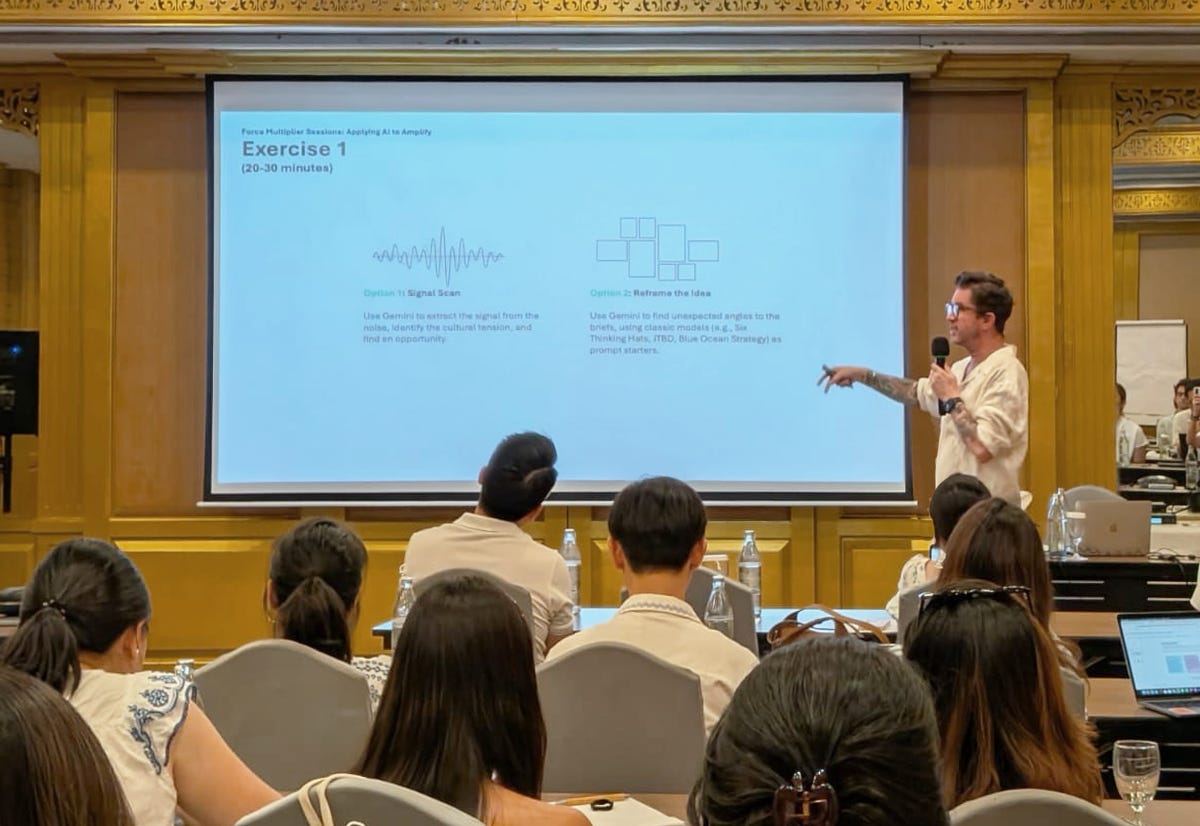
The old line, “those who can, do; those who can’t, teach”, was always bullshit. In our industry, the best teachers are the ones still in the arena. Practitioners who build, break, rebuild, and then show others how to do it better. Teaching is a force multiplier. And the people who do the work are often the ones best equipped to teach it.
If your organisation is ready to move past the “prompt tips and quick hacks” phase of AI, and into the deeper work of building systems, frameworks, and creative habits that scale, this is precisely the work I currently teach.
I train teams to think and operate differently and to use AI as a force multiplier for strategy, storytelling, and innovation.
If you want that kind of capability inside your walls, I’m ready. And I am only going to get better at it.


